Reviewed · FULL-DAY
Full Day Private Guided Istanbul Tour From Hotel or Cruise Ships
Istanbul’s grandest sights are packed into this private day tour, from the Blue Mosque and Hagia Sophia to the Grand Bazaar, Golden Horn, and Bosphorus area. The most useful feature is flexibility: your guide can shape the day around your interests instead of forcing you through a fixed group schedule.
I like the easy pickup from a central hotel or cruise port, and I like having a local guide to explain the layers of Byzantine, Ottoman, Jewish, Greek, Armenian, and Turkish Istanbul. The main caution is scope: 20 listed stops cannot all receive a full visit in seven or eight hours, and museum tickets, food, and transport cost extra.
In This Review
- Key points to know before booking
- What this private Istanbul tour really offers
- Starting in Sultanahmet, Istanbul’s great opening scene
- Topkapı Palace and the Ottoman court
- Hagia Sophia and the Blue Mosque
- The Hippodrome and Basilica Cistern
- Bazaars, spices, and the practical side of shopping
- Dolmabahçe Palace and the Bosphorus side
- Galata Tower, Taksim, and Istiklal Street
- Fener, Balat, and the Golden Horn
- Pierre Loti Hill and the question of transport
- Guide quality and the private format
- Who should book this tour?
- Should you book this private Istanbul tour?
- FAQ
- How long does the Istanbul private tour last?
- Where does the tour start and finish?
- Are museum and attraction tickets included?
- Is transportation included?
- Is Hagia Sophia skip-the-line access included?
- What happens if I need to cancel?
Key points to know before booking
- A private guide for your group: You will not be combined with strangers, and the route can be adjusted to your priorities.
- A strong first-day route: Sultanahmet, Topkapı Palace, Hagia Sophia, the Blue Mosque, Basilica Cistern, and Grand Bazaar cover Istanbul’s essential sights.
- Walking is central: Comfortable shoes matter, and public transport may be used at your expense if it helps the route.
- Museum fees are extra: Topkapı Palace, Basilica Cistern, Dolmabahçe Palace, Galata Tower, and the Bosphorus cruise are not included.
- Guide quality matters: Kivanc received especially warm praise for flexibility, practical advice, and clear explanations. Guide assignments are not guaranteed.
- The timing needs care: Dolmabahçe Palace closes Monday, Topkapı Palace closes Tuesday, and the Grand Bazaar closes Sunday.
What this private Istanbul tour really offers
At $67 per person, this is an inexpensive way to hire a private English-speaking guide for most of a day. The price looks especially good for couples, families, or small groups, since the guide’s attention is reserved for you rather than spread across a busload of people.
The catch is that the price does not cover the main paid attractions. You will need to budget separately for museum admissions, the Basilica Cistern, any Bosphorus boat ride, food, and possible tram or other public transport costs. The guide can help you decide where your money is best spent, but the tour price itself is not an all-inclusive admission package.
This is best understood as a guided orientation with selected interior visits, not a guaranteed deep visit to every place named. The route includes Sultanahmet, Eminönü, Beşiktaş, Galata, Taksim, Fener, Balat, Eyüp, and the Golden Horn. Those districts are spread across the city, so traffic, queues, prayer times, opening days, and your pace will shape the final day.
A few more Istanbul experiences to weigh up
- Istanbul: Full-Day Highlights Tour with Guide and Lunch
★ 4.6 · 1,662 reviews - From Istanbul: Full-Day Princes Island Tour with Lunch
★ 4.0 · 1,550 reviews - ISTANBUL BEST: Iconic Landmarks Full Day PRIVATE Guided City Tour
★ 5.0 · 1,032 reviews
Starting in Sultanahmet, Istanbul’s great opening scene
The stated meeting point is the German Fountain near the Hippodrome in Sultanahmet. If you are staying at a centrally located hotel, the guide can meet you there on foot. Cruise passengers are met on foot at the port gate, but you must provide the ship name, docking time, disembarkation time, and required return time when booking.
Sultanahmet is the right place to begin. In a compact area, you can see the Blue Mosque, Hagia Sophia, Basilica Cistern, Topkapı Palace, and the old Hippodrome. A guide earns their keep here by showing how the monuments relate to one another, rather than treating each as an isolated photo stop.
The opening district orientation is listed as 15 minutes, so do not expect a long formal walk before entering the sights. Use this time to tell your guide what matters most. If you care about Ottoman palace life, ask for more time at Topkapı. If you want architecture and underground Istanbul, prioritize Hagia Sophia and the Basilica Cistern.
Topkapı Palace and the Ottoman court
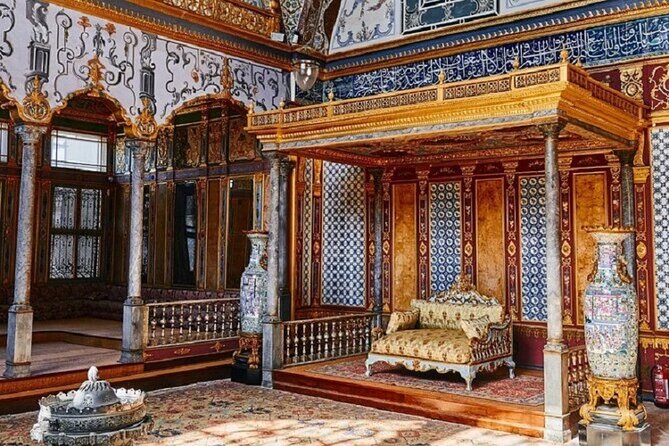
Topkapı Palace served as the administrative center and royal home of the Ottoman Empire for roughly four centuries. Its four courtyards form an open-air museum, with spaces linked to Sultan Mehmet II and the sultans who followed him until Sultan Abdulmecid.
The planned visit is only 30 minutes, and admission is not included. That is a short window for a palace complex of this size. I would not expect a complete visit to every courtyard and department. Ask your guide which sections are open and which areas best match your interests before paying to enter.
Topkapı is especially useful if you want context for the Ottoman state, the royal family, and the Enderun educational system. It gives the day a sense of scale, but it can also consume time quickly. If your guide spends too long outside and you want to enter, say so clearly. The itinerary is customizable, and that flexibility works only when you use it.
Remember that Topkapı Palace is closed on Tuesdays. If your visit falls on that day, the route will need to change.
Hagia Sophia and the Blue Mosque
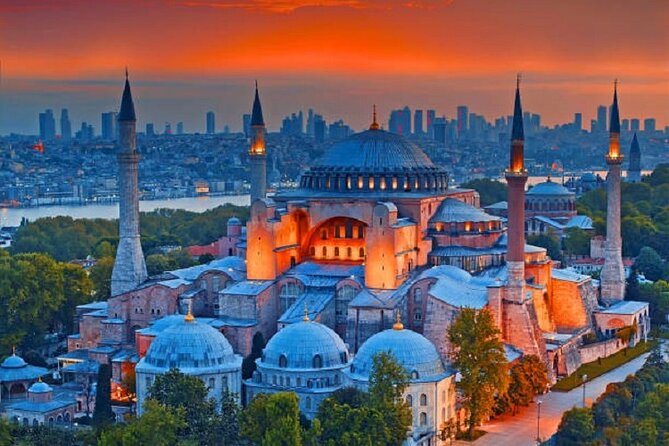
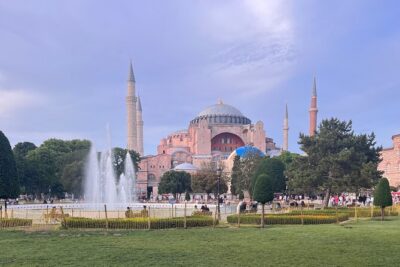
Hagia Sophia is one of Istanbul’s essential stops. Built three times at the same location, it served as a Greek Orthodox cathedral until the end of the Byzantine Empire, then became a mosque after the Ottoman conquest of Constantinople in 1453. Its huge dome, Byzantine mosaics, and Ottoman additions show several chapters of Istanbul in one building.
The planned stop is 30 minutes, and admission is not included. The guide does not have priority access through Hagia Sophia’s ticket and security lines, so you may wait. This is one of the most important practical warnings in the tour details. If you are visiting during a busy period, a short timetable can stretch considerably.
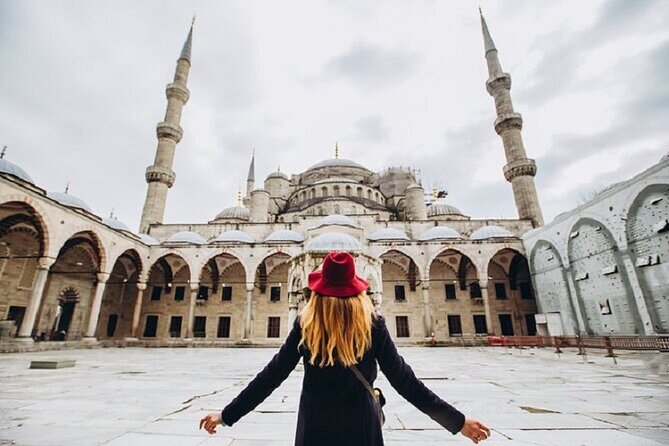
Across the square, the Blue Mosque offers a different style of grandeur. Built for Sultan Ahmet I and completed in 1617, it is known for its handmade blue İznik tiles and six minarets. The visit is also listed at 30 minutes, with no admission fee, though it remains a working mosque rather than a museum.
Dress rules matter. Women need to cover their heads, shoulders, and knees. Men need to cover their knees if wearing shorts or bermuda shorts that end above the knee. Scarves and wraps are available at mosque entrances for a charge, so carrying your own scarf is the simpler option.
Two continents, plenty of other ways to spend a day:
- Istanbul: Bosphorus Dinner Cruise & Show with Private Table
★ 4.8 · 44,561 reviews - Istanbul: Daytime or Sunset Sightseeing Cruise & Audio Guide
★ 4.8 · 14,430 reviews - Istanbul: Bosphorus Dinner Cruise with Turkish Night Show
★ 4.8 · 10,127 reviews - Best of Istanbul 1, 2 or 3-Day Private Guided Istanbul Tour
★ 5.0 · 8,922 reviews
The Hippodrome and Basilica Cistern
The Hippodrome is now an open urban space, but it once formed the center of Byzantine public life. Your guide can point out the Egyptian Obelisk, brought from Egypt to Istanbul in the fourth century, the Serpentine Column from Delphi, and the Column of Constantine.
The stop is listed at 15 minutes and is free. That is enough to identify the monuments and hear the basic story, but not enough for a long archaeological discussion. Look carefully at the columns, because their weathered condition is part of the story. The Serpentine Column once had three bronze snake heads, though those are now gone.
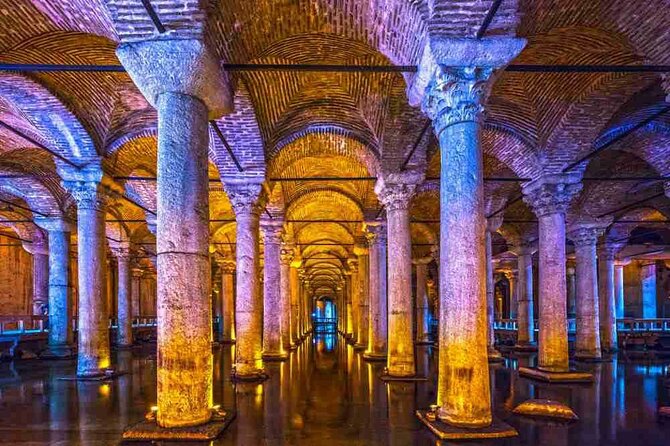
Below the streets, the Basilica Cistern feels like a change of world. It was built to hold about 80,000 cubic meters of water and is the largest and best excavated of the underground cisterns open to the public. Its columns, dim atmosphere, and filmed setting make it one of the day’s most memorable interiors.
The planned visit is 30 minutes, and the admission fee is extra. That timing gives you a useful look, though you may want longer if you enjoy old engineering, stonework, or photography. The cistern lies close to Hagia Sophia, so it fits naturally into the Sultanahmet portion of the day.
Bazaars, spices, and the practical side of shopping

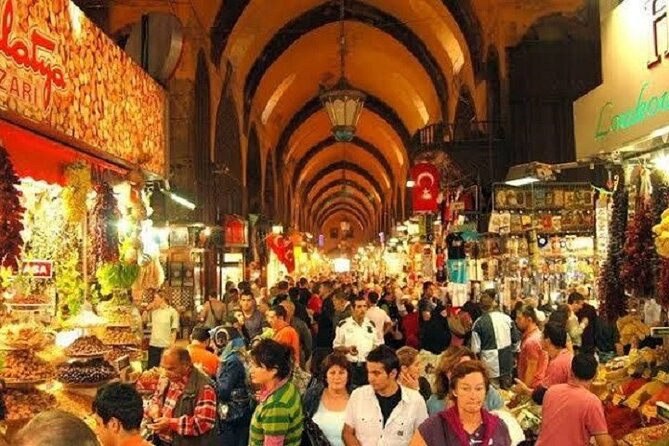
The Grand Bazaar dates from 1461, after Sultan Mehmet II’s conquest of Istanbul. Its covered lanes are arranged by trade, with streets historically associated with particular goods. You can walk through the old market atmosphere without paying admission.
The planned stop is 30 minutes. That is enough to get oriented and see the character of the building, but it is not a serious shopping session. If you want carpets, jewelry, leather, or other purchases, say so at the start. Bargaining and browsing can easily take longer than the schedule allows.
The Spice Market, also called the Egyptian Bazaar, sits behind the New Mosque in Eminönü. Built in 1660 as part of the mosque complex, it was funded in part by taxes on Egyptian imports. Spices still make up a large share of its shops, giving this stop a more focused feel than the sprawling Grand Bazaar.
You have 25 minutes here. I like this pairing because it lets you compare two different markets in one day. The Grand Bazaar is a maze of trades and lanes. The Spice Market is easier to grasp quickly and offers a direct look at Istanbul’s long connection with imported foods and seasonings.
The Grand Bazaar is closed Sundays. Plan around that if shopping is important to you.
Dolmabahçe Palace and the Bosphorus side
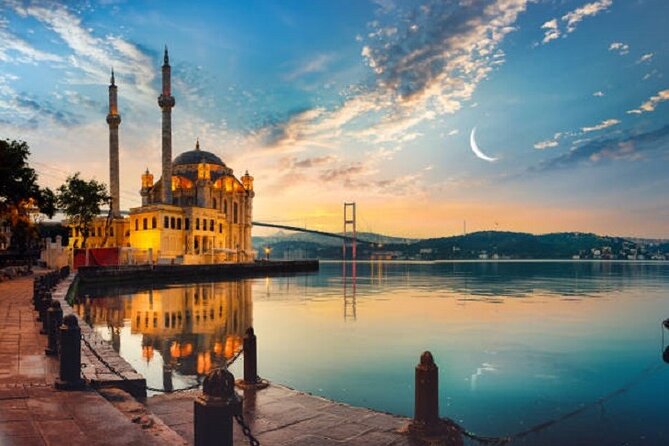
Dolmabahçe Palace sits on the southern shore of the Bosphorus in Beşiktaş. Built in the mid-19th century, it served as a residence for the last six Ottoman sultans at different times. Its Baroque, Rococo, and Neoclassical influences make it a sharp contrast to Topkapı’s older Ottoman court setting.
The tour allows one hour here, but admission is extra. Of all the palace stops, this one needs especially careful planning. A 60-minute visit may work for a selected look, but waiting, security, and the palace layout can affect how much you see.
Dolmabahçe is closed Mondays. If it is a must-see, confirm the day before booking. The private format helps because your guide can shift attention elsewhere, but no guide can make a closed palace available.
The itinerary also lists a Bosphorus Bridge stop and describes a Bosphorus boat cruise lasting 30 minutes. The cruise fee is not included. You should clarify before the day begins whether the plan is a brief viewing stop, an actual boat ride, or both, because these are different uses of your limited time.
A boat trip is worthwhile if you want to see imperial palaces, waterfront mansions, and Istanbul from both the European and Asian sides. But it may require a ticket and additional transport. At $67, this is not a bundled cruise tour.
Galata Tower, Taksim, and Istiklal Street
Galata Tower is the major surviving structure from the Genoese colony in Istanbul. It rises above the Golden Horn entrance and has been restored and reused over the centuries. The tower is one of the city’s easiest landmarks to recognize, and the surrounding streets lead into a more European-feeling part of Istanbul, with small shops, cafés, and brick-paved lanes.
The listed stop is 30 minutes, with admission extra. That may give you time to see the tower from outside and explore nearby streets, but entering the tower may take longer, especially if there is a queue. Confirm the intended plan with your guide before treating the tower admission as part of the day.
Taksim Square is a 15-minute stop, followed by 10 minutes on Istiklal Caddesi. Taksim was historically tied to the distribution of water across the city and is now a major central meeting point. Istiklal Street runs through the area, with its historic tram and long commercial axis.
These stops are useful for seeing modern Istanbul, but they are brief. I would choose them over another bazaar only if you specifically want the city’s contemporary center, old tram, shops, and café streets.
Fener, Balat, and the Golden Horn
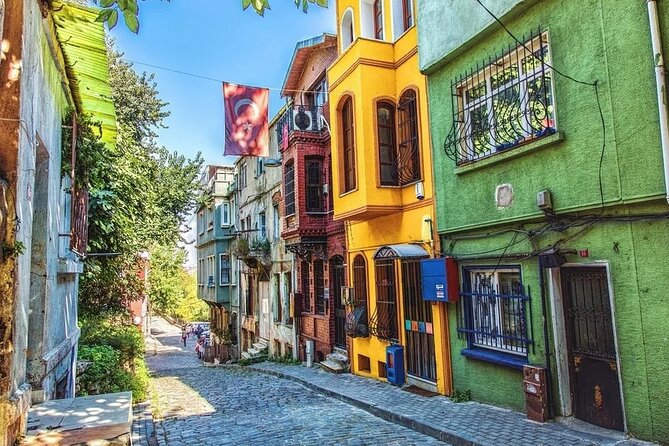
Fener and Balat offer a different view of Istanbul from the imperial monuments. Their hilly cobbled lanes, colorful Ottoman houses, workshops, cafés, and religious buildings create a neighborhood walk rather than a grand-sight circuit.
Fener was home to Greek-speaking communities, while nearby Balat became associated with Jewish residents, including Sephardic Jews expelled from Spain in the 15th century. Churches, synagogues, mosques, and small businesses reflect that layered past. The tour also includes the Fener Greek Patriarchate, the Patriarchal Church of St. George, and the Bulgarian Orthodox Church of Saint Stephen.
The listed times are short: 10 minutes for Fener and 10 for Balat, followed by 10 minutes each at the patriarchate, St. George, and Saint Stephen. That is enough for a quick look, not a full neighborhood walk. If these districts interest you most, ask your guide to reduce the number of other stops.
Saint Stephen is known locally as the Iron Church because it was built from iron and steel for Istanbul’s Bulgarian community during the final years of the Ottoman Empire. Its restored interior and icon wall give you a specific architectural reason to visit, not just another scenic street.
The Golden Horn, or Haliç, was once a major trading harbor and residential zone. Its shores reflected the city’s mixture of Jewish, Armenian, Greek, Roma, and Turkish communities. The tour gives this area 10 minutes, so expect a brief view and explanation rather than a long waterfront outing.
Pierre Loti Hill and the question of transport
Pierre Loti Hill in Eyüp is named for the French writer Julien Viaud, who settled in Istanbul in 1876 and wrote at a coffeehouse in the area. The hill is presented as a scenic, romantic place overlooking the Golden Horn, with a 10-minute stop.
This part of the route is far from Sultanahmet and the central historic sights. Since transportation is not included, ask exactly how you will get there. The tour is described as a walking tour, yet the details also allow public transportation when useful, with fares paid by you.
That distinction matters. Istanbul is a large city, and moving between Sultanahmet, Beşiktaş, Galata, Fener, and Eyüp on foot would take much longer than the advertised seven or eight hours. The route will work best when you and the guide agree on a realistic set of priorities rather than trying to check every place.
Guide quality and the private format
The strongest part of this experience is the chance to work with one guide who can adjust the day. Guides named in the available feedback include Atilla, Kaya, Huseyin, and Kivanc. Kivanc received especially strong praise for adapting to requests, explaining Turkish and Istanbul history, and offering practical advice for getting around.
Kaya was also described as flexible and helpful with communication. Huseyin was credited with moving efficiently from one location to another. These details point to what you should ask for when booking: a guide who can balance sights, walking, transport, and your own pace.
There is also a serious warning. One poor experience involved inappropriate comments, skipped sights, impatience with photographs, and a disagreement about entering a palace. The operator said that guide was no longer employed and explained that a city race had disrupted transport that day. That response does not erase the experience, but it gives you a reason to confirm your guide’s name, meeting point, and planned route before starting.
The private format lets you stop for pictures and ask questions. It does not guarantee that every listed stop will be visited in full. Be direct: tell your guide which three or four sights are non-negotiable.
Who should book this tour?
I would choose this tour for a first visit, especially if you have only one full day in Istanbul or are coming from a cruise ship. It gives you a local point of contact, a central meeting arrangement, and a way to combine famous monuments with neighborhoods you might not reach on your own.
It also suits families and small groups that want to set their own pace. The 4.5 rating and 91 percent recommendation figure suggest a generally strong experience, though the small number of ratings means you should not treat those numbers as a guarantee.
I would be cautious if you want a slow museum day. The route is too broad for leisurely time inside Topkapı, Dolmabahçe, Hagia Sophia, and the Basilica Cistern all at once. You will get better value by selecting your priorities before the tour.
Free cancellation is available up to 24 hours before the start time. The tour requires good weather and a minimum number of participants, so a cancellation caused by weather or insufficient bookings may lead to another date, another experience, or a full refund.
Should you book this private Istanbul tour?
Book it if you want a flexible city introduction, a private guide, and help connecting Istanbul’s major sights. At $67 per person, the guiding cost is attractive, particularly for a small group.
Before booking, mark your essential sights, check the weekly closures, and budget for admissions and transport. Ask how the guide will handle the Bosphorus cruise, how much time will be spent inside the palaces, and whether the route is realistic for your available hours.
I would not book it expecting all 20 stops to receive equal attention. I would book it as a smart framework, then use the private format to turn a long list into a day that fits your interests.
FAQ
How long does the Istanbul private tour last?
The tour lasts approximately seven to eight hours.
Where does the tour start and finish?
The stated meeting point and ending point are the German Fountain in Sultanahmet. If you book from a centrally located hotel, the guide can meet you there on foot. Cruise ship passengers meet the guide at the port gate on foot.
Are museum and attraction tickets included?
No. Museum and attraction admission fees are extra. This includes listed paid stops such as Topkapı Palace, Hagia Sophia, the Basilica Cistern, Dolmabahçe Palace, Galata Tower, and the Bosphorus cruise.
Is transportation included?
No. The experience is described as a walking tour. If public transportation is used, you pay those fares. Extra pickup charges may apply if your hotel is outside the central area.
Is Hagia Sophia skip-the-line access included?
The guide can skip some ticket lines with official tour-guide access, but there is no skip-the-line priority at Hagia Sophia. You may need to wait in the ticket and security lines.
What happens if I need to cancel?
You can cancel at least 24 hours before the start time for a full refund. Cancellations or changes made less than 24 hours before the start time are not accepted for a refund. If poor weather or insufficient bookings cancel the tour, you will be offered another date or experience, or a full refund.
Latest additions around Istanbul
- Istanbul: Hagia Sophia Skip-the-Line Ticket with Live Guide★ 3.7 · 3 reviews
- Ephesus Private Tour From Istanbul including transfers & domestic fights★ 5.0 · 3 reviews
- 6 Days Multi City Turkey Tour★ 5.0 · 3 reviews
- Princess Islands Daily Tour from Istanbul★ 5.0 · 3 reviews
- Premium Line : Private Istanbul Tour : All Inclusive Package★ 4.3 · 3 reviews
- Private Istanbul Combo Tour – Classic Old City and Bosphorus Cruise★ 5.0 · 3 reviews
- Private tour: 12-Day Turkish Adventure Package Tour From Istanbul★ 4.5 · 3 reviews
- Istanbul: Hagia Sophia Guided Tour with Optional Ticket★ 3.3 · 3 reviews
Full-Day, compared.
Full-Day Highlights Tour with Guide and Lunch
Read our review →
ISTANBUL BEST: Iconic Landmarks Full Day PRIVATE Guided City Tour
Read our review →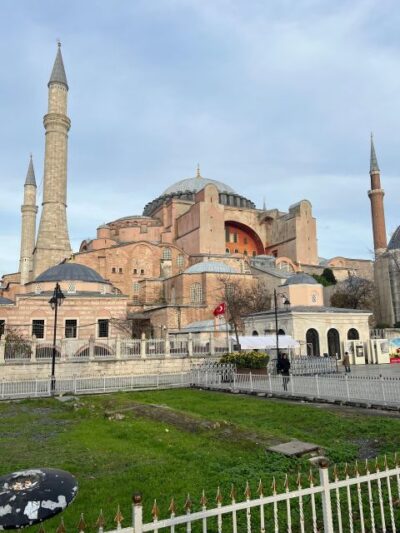

Istanbul to Gallipoli Full Day Tour with Lunch and Transfers
Read our review →

Full Day Istanbul 1, 2 or 3-Day Private City Guided Tour
Read our review →